Can You Copyright AI-Generated Content?
What Business Owners Need to Know Before Using AI for Branding and Marketing
“AI is taking all the copywriting jobs.”
That’s the narrative floating around LinkedIn.
But after listening to an episode of the Build Your Copywriting Business featuring agency owner Amber Smith, I found myself thinking about a different question entirely: If you use AI to create something… do you actually own it?
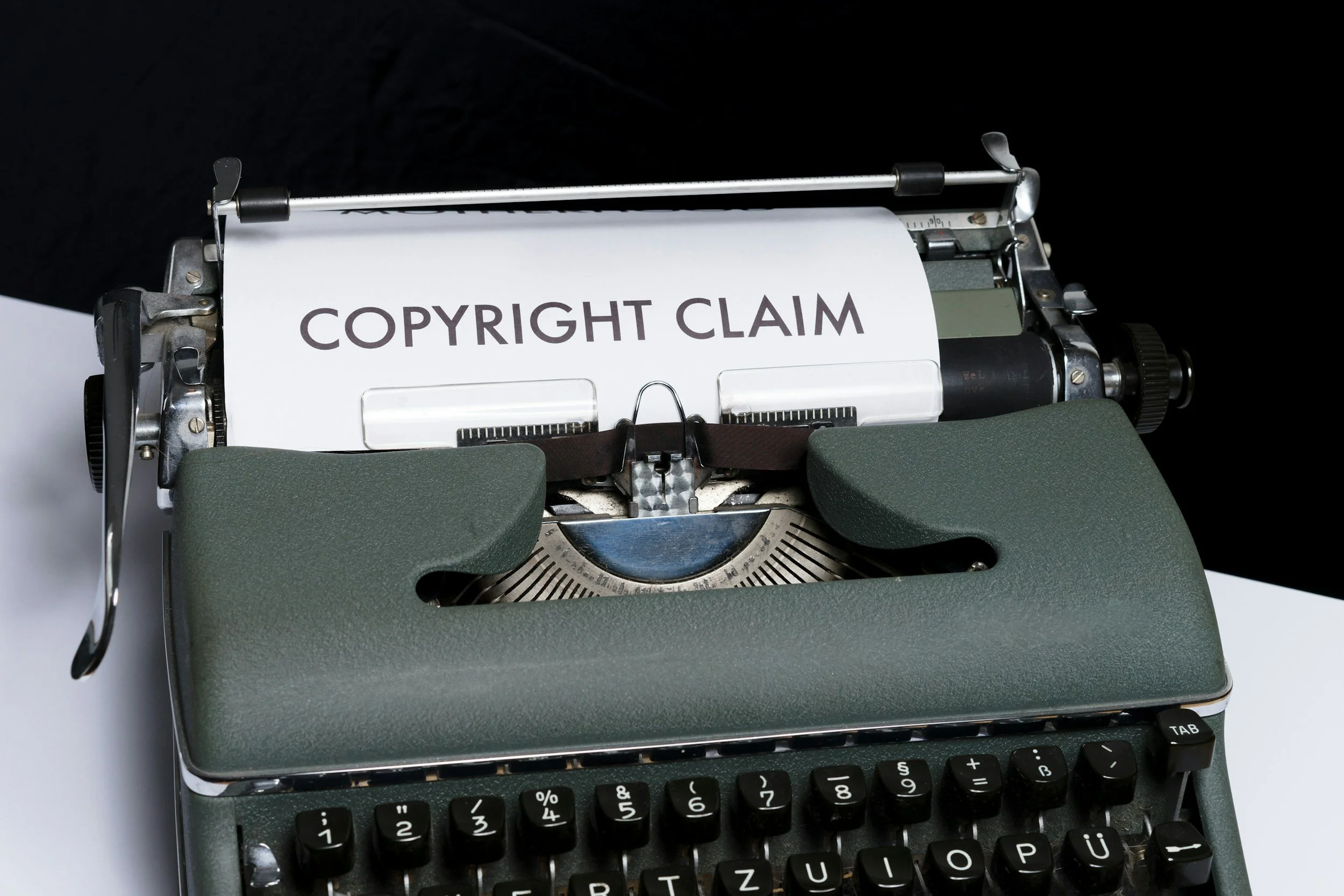
The conversation around AI tends to focus on productivity and job security, but for business owners, there’s a more pressing issue: Copyright. Ownership. Brand protection. Because AI isn’t just a productivity hack, it raises uncomfortable questions about ownership. And if you’re using it to generate logos, product names, website copy, or marketing campaigns, that gray area matters.
What the U.S. Copyright Office Says About AI
The U.S. Copyright Office has been clear: copyright protects works of human authorship.
If content is generated entirely by artificial intelligence without meaningful human creative control, it is not eligible for copyright protection under current U.S. law.
That means fully AI-generated:
Blog posts
Website copy
Marketing materials
Graphics and illustrations
Logos
Product names
may not be legally protected the way you assume.
Ideas are not copyrighted. Expression created by humans is. If there’s no human author, ownership becomes murky.
The Logo and Product Name Risk
This is where the issue becomes practical. Imagine you use an AI tool to generate a logo for your company. You love it. You launch your website. You print packaging. You invest in signage.
But if that logo was generated entirely by AI, you may not be able to claim copyright over the design itself.
That creates risk:
You may not have exclusive rights to the artwork.
Someone else could generate a similar design.
Enforcement becomes complicated.
The same concern applies to product names.
If you prompt an AI tool to create a unique name for your skincare line or SaaS platform and publish the first result without substantial human development, you may not have clear authorship over that name.
Brand identity is one of the most valuable assets a company owns. If it isn’t protectable, that’s not a minor detail.
AI-Assisted vs. AI-Generated: The Critical Difference
There is an important distinction between:
Fully AI-generated content
Human-directed, AI-assisted content
Courts and regulators look at human creative control.
If you:
Use AI for research or brainstorming
Build on its output with substantial editing
Restructure and rewrite
Inject strategy and brand voice
Make meaningful, creative decisions
Then the human-authored portions may qualify for copyright protection.
AI can be a tool. It cannot be the author. If you hit generate and publish without shaping the work yourself, ownership becomes far less clear.
The Legal Landscape Is Still Evolving
In 2023, authors including George R. R. Martin and John Grisham joined litigation alleging that OpenAI trained its systems on copyrighted works without permission.
While those cases focus on training data rather than output ownership, they highlight a broader reality: AI and copyright law are actively colliding in real time.
At the state level, regulation is emerging as well. In 2024, Governor Jared Polis signed the Colorado Artificial Intelligence Act, which will take effect in 2026. Although the law focuses primarily on predictive AI systems making consequential decisions in areas like employment and lending, it signals something important:
AI is becoming a compliance issue, not just a creative tool. Businesses are expected to understand how they use it and what risks it introduces.
The Overlooked Risk: Brand Dilution
Beyond copyright, there’s another issue I see as a working copywriter. Homogenization. AI predicts language based on patterns it has already seen. If multiple businesses in the same industry use similar prompts, they begin sounding the same. Brand voice flattens. Differentiation disappears. Messaging becomes interchangeable.
And when your marketing sounds like everyone else’s, your competitive advantage erodes quietly. AI does not understand positioning. It does not weigh long-term brand equity. It does not understand consequences. It predicts the statistically likely next word. That’s not a strategy.
How to Use AI Responsibly in Your Business
AI is not the villain. It is also not a substitute for authorship.
A responsible approach looks like this:
Use AI for:
Research synthesis
Brainstorming
Pattern recognition
Administrative efficiency
Do not outsource:
Core positioning
Brand strategy
Messaging frameworks
Final deliverables
Creative direction
And do not assume that everything generated through a prompt automatically belongs to you.
Ownership comes from authorship. Authorship requires human judgment.
The Question You Should Be Asking
Before publishing AI-assisted work, ask:
Is there meaningful human creative control here?
Can I defend ownership of this asset?
Does this reflect my brand’s true positioning?
Would I feel comfortable protecting this legally?
AI can speed up parts of your workflow.
It cannot replace the responsibility of protecting your brand.
If you want marketing that is both persuasive and protectable, you need more than output. You need authorship.
About Shelby’s Copy Studio
At Shelby’s Copy Studio, I help brands build messaging that is strategic, distinct, and defensible. AI can support the process. It does not replace it.
If you’re experimenting with AI in your marketing and want to make sure your brand voice and intellectual property are protected, let’s talk.